Every football season delivers a handful of results that leave fans and pundits stunned. A relegation candidate defeats a title challenger. A mid-table club frustrates a European giant. The headlines call them shocks, and the post-match analysis usually focuses on passion, determination, or an inspiring team talk.
Yet beneath almost every upset lies a pattern that was visible before the match even kicked off.
At ScoreVoro, we don’t view surprising results as random events. We see them as outcomes that sit on the edge of a probability curve—uncommon, but rarely impossible to anticipate. While no model can predict every surprise, the right combination of data often reveals warning signs long before the final whistle.
Looking Beyond Recent Results
One of the biggest mistakes bettors make is judging a team’s form solely by recent results. Five consecutive wins or three straight defeats may look convincing, but they don’t always reflect how well a team is actually playing.
A winning streak against weaker opponents can easily mask declining performances. Likewise, a team suffering a run of poor results may actually be improving beneath the surface. Metrics such as expected goals (xG), shot quality, possession in dangerous areas, pressing intensity, and defensive organization often provide a far more accurate picture than the league table alone.
That’s why our prediction models place greater emphasis on underlying performance than on final scorelines.
A narrow 1-0 victory earned through a fortunate deflection and several outstanding saves tells a very different story from a controlled 1-0 win built on sustained pressure and quality chance creation—even if both matches award the same three points.
The Myth of Momentum
“Momentum” is one of football’s most overused terms. While commentators often describe teams as carrying confidence from one match to the next, football is far less predictable than that.
Each game presents a new tactical challenge with different players, conditions, and motivations. What actually carries over from match to match isn’t momentum—it’s measurable factors such as squad fitness, tactical consistency, player availability, and motivation.
As we often say internally:
The biggest predictive mistake in football isn’t choosing the wrong team—it’s assuming the reasons behind last week’s result will automatically apply this week.
This philosophy explains why ScoreVoro separates markets like Must Win Teams and Banker Tips instead of combining everything into a simple form rating.
Motivation can significantly influence performance, but it represents a different signal from a team’s overall quality. Treating those factors independently produces more reliable predictions than blending them into one generic measure.
Where Football Upsets Really Come From
When we review matches our models identified as having upset potential, the same patterns appear repeatedly.
Fixture Congestion
Teams playing their third match in eight or nine days often experience physical and mental fatigue, particularly when facing an opponent with a full week’s rest.
New Manager Impact
A managerial change frequently produces a short-term improvement. Opponents have limited tactical information, while players often respond with increased intensity during the first few matches under new leadership.
Squad Rotation
Markets sometimes overreact when key players are rested. In reality, fringe players can provide fresh energy and may arrive in excellent individual form, making the overall drop in quality much smaller than public perception suggests.
Travel and Environmental Conditions
Long-distance travel, climate differences, altitude, and unfamiliar playing conditions continue to influence performance—especially in continental competitions—yet these factors are often underestimated by betting markets.
Referee Tendencies
Different referees consistently award penalties, yellow cards, and added time at different rates. These patterns subtly influence expected goals and match dynamics, creating value that headline odds don’t always fully reflect.
None of these variables guarantees an upset on its own.
However, when several of them align in the same fixture, the difference between market probability and our model’s estimated probability can become significant. Those situations are where genuine betting value is most likely to exist.
Why Confidence Ratings Matter
No prediction model—ours included—can eliminate uncertainty from a sport where one mistake, one deflection, or one moment of brilliance can completely change a result.
The purpose of data-driven analysis isn’t to predict every individual match correctly. Its purpose is to improve long-term decision-making across hundreds or even thousands of fixtures.
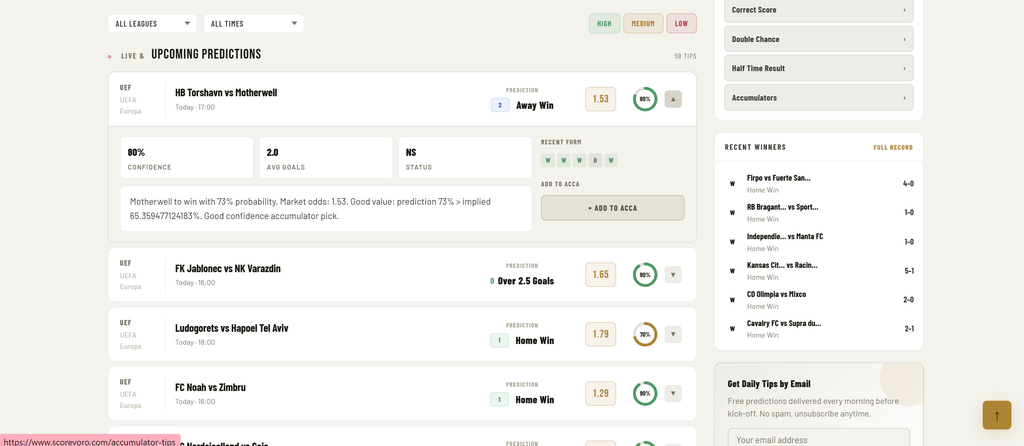
That’s why every prediction published on ScoreVoro includes a confidence rating rather than a guarantee.
A tip rated at 78% confidence is still expected to fail approximately one out of every five times. That isn’t a weakness of the model—it’s simply how probability works.
Successful bettors understand this distinction. They evaluate performance over the long run instead of judging a prediction by a single result.
The Bigger Picture
The next time a football result is described as a major shock, look beyond the scoreline.
Was one team carrying a heavier fixture schedule?
Did a new manager introduce an unfamiliar tactical approach?
Were the underlying performance numbers quietly improving despite recent defeats?
Was motivation stronger for one side than the other?
More often than not, the warning signs were already there—they simply weren’t obvious to those focusing only on recent results.
That philosophy forms the foundation of every prediction we publish at ScoreVoro. Rather than chasing emotional narratives or reacting to headlines, we follow the underlying data that consistently explains football matches more accurately than short-term storylines ever can.
Because in football, the biggest surprises often aren’t surprises at all—they’re simply the outcomes the numbers hinted at long before kickoff.